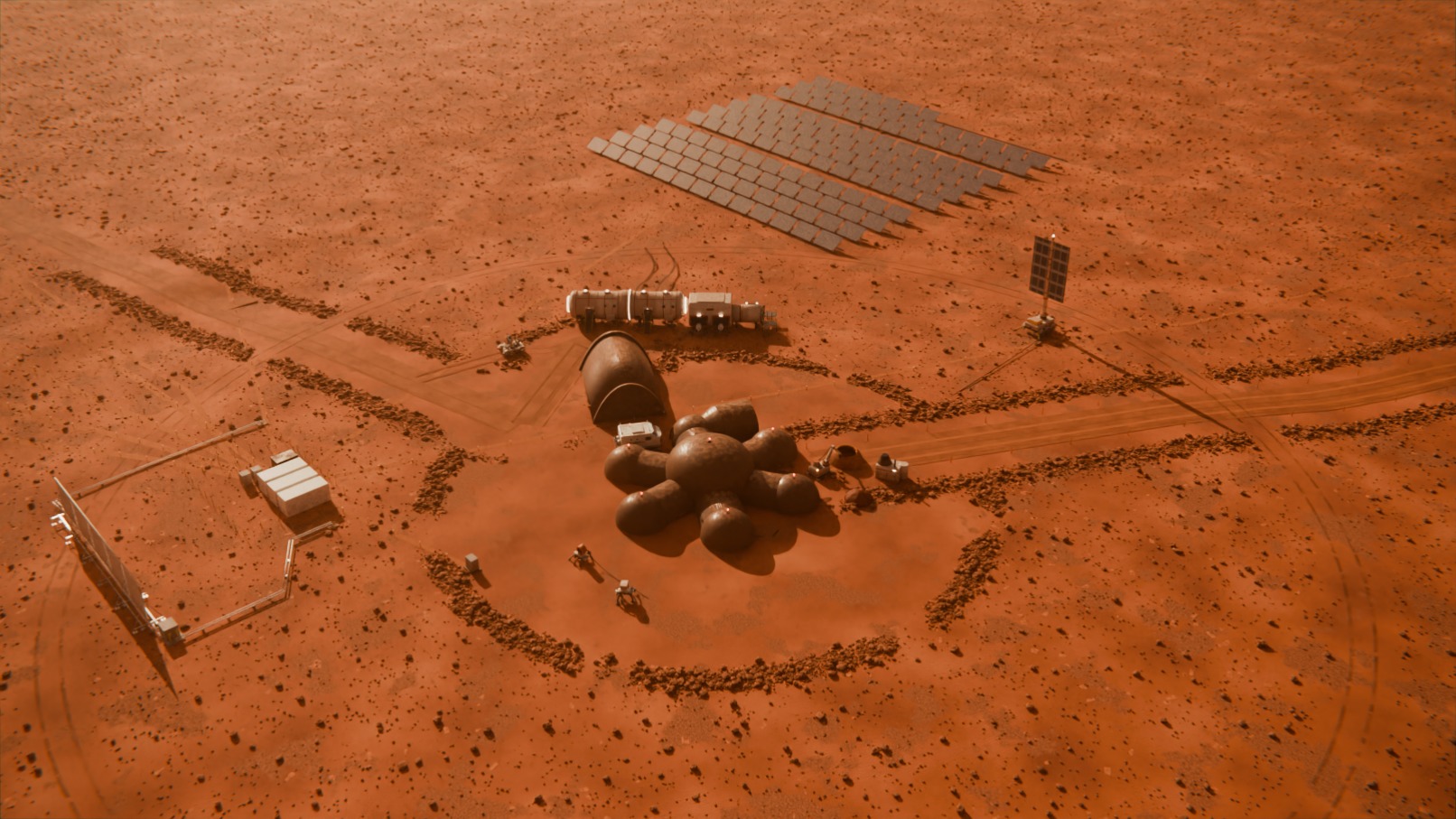
A Mars habitat for six people: a soft pressure vessel, packed small for landing, inflated in a shallow pit and buried under a 1 m shell of kiln-sintered regolith blocks with a laser-glazed outer skin. Robots build it all before the crew arrive.
Design concept · not flight hardwareSystem TRL 2–3 (our assessment)Built on flight-proven heritageNot an agency mission
1.0msintered regolith shell, about 160–180 g/cm² est.
about 1.0mhub pit depth; a steep-walled shell keeps a 0.5 m gap all round the vessel
about 390–440tregolith in the hub shell (1.6–1.8 t/m³), none of it launched est.
5 × 40kWefission, 4 duty + 1 spare (N+1), about 1 km out est.22
39.17°N195.60° E, Arcadia Planitia, shallow ground ice1,2
01 / CONCEPT
Pressure in fabric, protection in rock
CAIRN-7 splits the two hardest jobs of a surface habitat between two materials. The inflatable vessel holds the air. The regolith shell stops radiation, micrometeoroids and the thermal swing, and is never asked to hold pressure.
Fabric vessels are one of the most mass-efficient ways to land a large pressurised volume: they launch folded and open to about twice their packed diameter (about 4.3 m packed to 8.7 m for the hub). TransHab's development and BEAM, flown to the ISS in 2016, show the restraint-and-bladder approach works7,8, and Sierra Space burst a full-scale expandable at 77 psi against a 60.8 psi requirement (tested December 2023, reported January 2024)9.
Shielding is the opposite problem: it is heavy, and it is already on Mars. A 1 m shell over the hub is about 390–440 t of material. Shielding an inflatable under a shell printed from local regolith is the idea ESA and Foster + Partners explored for a lunar base10; CAIRN-7 swaps their binder printing for kiln-sintered blocks and a laser-glazed outer skin.
Robots land first, a full launch window (26 months) ahead of the crew. They dig the shallow pits, lay the foundation rings, inflate the vessels, raise the shells around them and start making oxygen. The crew arrive to a base that is already pressurised, powered and producing.
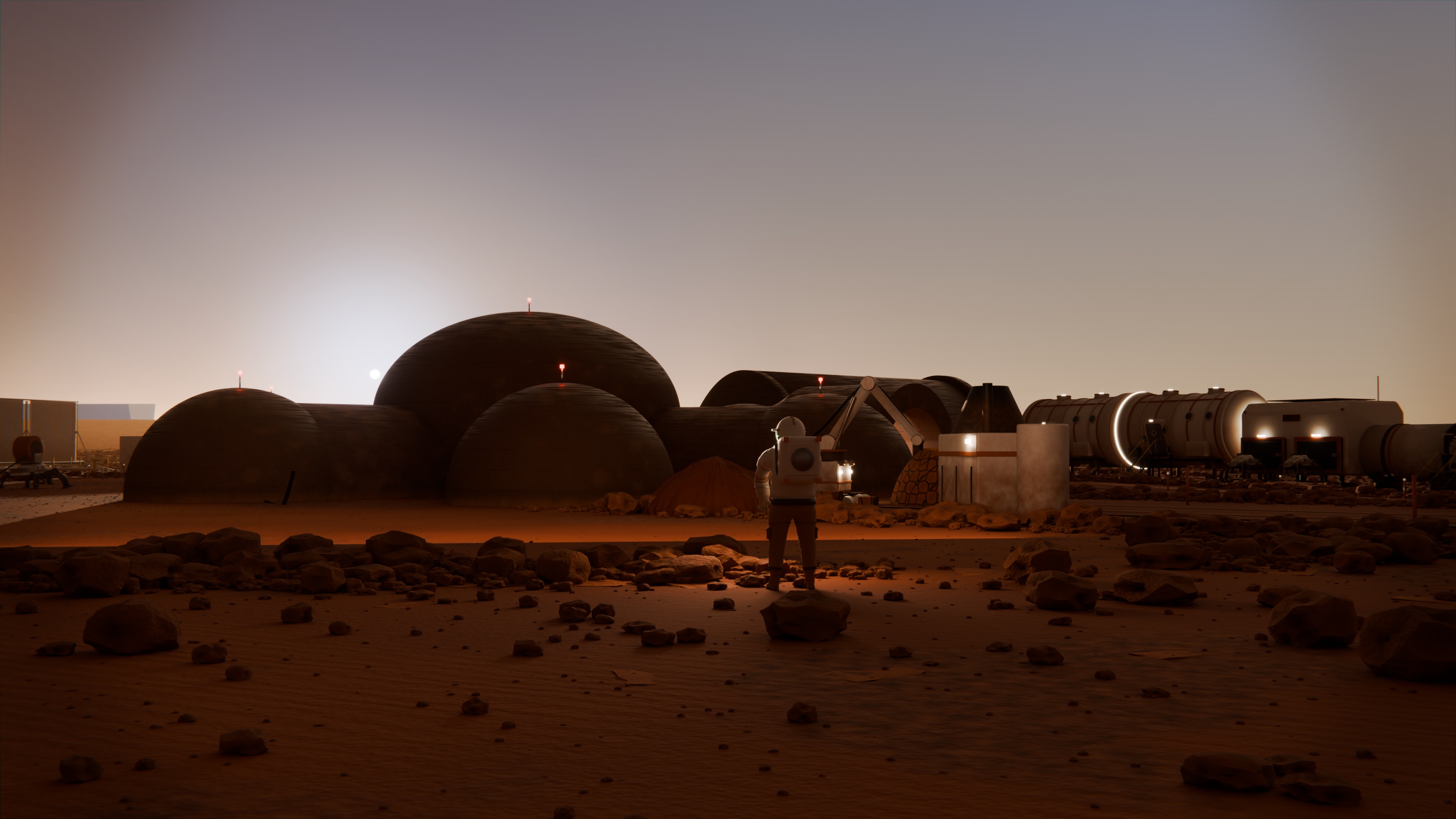
CAIRN-7 at blue hour. The hub and pod shells after sunset, with a suited crew member for scale.
02 / PLAN
A hub and six pods on an 11.5 m ring
The hub carries the shared life of the base on two decks. Six smaller pods sit on a ring around it, each joined to the hub by its own buried, sintered vault tunnel. One pod is the EVA node, with the walk-through airlock and suitports.
Plan, schematic, to scale. Pods at 30°, 90°, 150°, 210°, 270° and 330°, with the EVA node at 210°. Tunnel joints and hatches are simplified.
Element
Size
Role
Hub
Ø 8.7 × 6.6 m about 347 m³
Two decks: communal (galley, table for six, lounge, ops) and private (six cabins, wash unit, quiet nook). A rigid life-support core runs through both decks, with two stairways.
Pod D2 · Lab
Ø 4.0 × 3.3 m about 33 m³
Sample analysis and sealed storage.
Pod D3 · Gym
about 33 m³
Treadmill, cycle, flywheel resistive device; about 2.5 h per crew member per day.
Pod D4 · Greenhouse
about 33 m³
Three-tier rack ring, about 20 m² of growing area est., part of about 60 m² across the base. A fresh-food supplement, not a full diet.
Pod D5 · Medical
about 33 m³
Sick bay and lockable isolation room with its own WC and HEPA, on the stretcher route from EVA; each vestibule ramps the 0.3 m level change est.
Pod D6 · Workshop
about 33 m³
3D printers, spares, suit and robot repair, stowage.
EVA node
vault about 10.7 × 8.2 × 4.5 m
Catenary-arch dust porch, walk-through airlock and suitports26.
Laboratory that doubles as an independent safe haven; an EDEN ISS-class greenhouse module; a robot module with its own airlock.
03 / SECTION
A steep-walled shell over a shallow pit
The hub vessel sits in a pit about 1 m deep. The shell's wall rises vertically for 3.31 m and then domes, so it keeps a 0.5 m vented gap around the whole vessel, shoulder included. All tunnel hatches open on the hub's lower, communal deck, a 0.3 m level change from the pod floors, so no one passes the cabins upstairs.
Section A–A through the hub, to scale (1 m = 34 units). Since 29 November 2026 the shell has vertical walls and a dome, so the vessel keeps a 0.5 m vented gap all round; the renders on this page show the earlier, rounder profile. Figures 1.75 m tall. The shell sits on its foundation ring, never on the vessel.
Level
Elevation
Use
Floor
Private deck (upper)
+2.10 m
Six crew cabins with water-jacketed walls that double as the storm shelter; WC and shower; quiet nook. No through traffic: crew moving between the hub and pods stay on the deck below.
35.3 m² at ≥2.5 m 47.9 m² at ≥2.0 m
Communal deck (lower)
−0.70 m
Galley, table for six, lounge with screen wall, ops and comms, second WC, racks. All tunnel hatches open here. As the full-height deck, it gives the shared rooms 2.5 m clear wall to wall.
about 42 m² net, 2.5 m clear
Floor areas are measured to the inner liner, about 0.15 m inside the vessel wall, and include the core.
04 / PRESSURE VESSEL
A TransHab-class layup, rethought for Mars air
In orbit an inflatable needs multi-layer insulation and a micrometeoroid blanket. Under a regolith shell it needs neither, but it does sit in thin carbon dioxide, where MLI performs poorly. So the layup changes.
Wall build-up, outside to inside
Dust coverouter
Aerogel / foam insulation (no MLI: the gap is open to about 0.6 kPa CO₂)thermal
No micrometeoroid layer: the regolith shell does that job. The rigid life-support core and the hatches are the main penetrations through the soft goods.
Worked check · restraint load (ours)
hoop load  N = p · r
at 56.5 kPa:   56.5 kPa × 4.35 m ≈ 246 kN/m
at 226 kPa:    226 kPa  × 4.35 m ≈ 983 kN/m
Every metre of restraint around the cylinder carries about a quarter of a meganewton at working pressure, and is rated for four times that. A hemispherical end would carry half the cylinder's hoop load. Our 2.29 m cap is flatter: near its crown it carries about the cylinder's load, and near its rim the hoop direction goes slack, so the restraint there needs a shaped (isotensoid) strap pattern. The full paper sizes it.
Why 56.5 kPa and 34% oxygen
A lower cabin pressure shortens the pre-breathe before a spacesuit EVA and lowers the load on every seal. At 56.5 kPa with 34% O₂ the oxygen partial pressure is 19.2 kPa, close to sea level on Earth. CO₂ is held at or below 0.40 kPa4,5. The price is fire risk: cabin materials must be qualified for 34% oxygen.
05 / REGOLITH SHELL
A shield, never a pressure hull
The shell is a sandwich: two 0.15 m skins of interlocking blocks, sintered in a kiln before placement, radial webs at most 1 m apart, a compacted regolith core, and an outer skin laser-sintered into a sealing glaze. Its wall rises vertically for 3.31 m and then domes; a ring beam at the wall head takes the dome's outward thrust. It stands on a foundation ring and works only in compression.
Worked check · could the rock hold the air in? (ours)
uplift on the hub   56.5 kPa × π × 4.35² ≈ 3.36 MN
weight of the shell ≈410 t × 3.71 m/s² ≈ 1.52 MN
regolith depth to balance 56.5 kPa:
   p / (ρ g) = 56 500 / (1 700 × 3.71) ≈ 9.0 m
At Mars gravity the air pushes up more than twice as hard as a 1 m shell weighs down. Holding the pressure with dead weight would take about 9 m of regolith. So the fabric vessel carries all of the pressure, and the shell is designed as a shield.
Areal density
1.0 m of sintered and compacted regolith at about 1.6–1.8 g/cm³ gives about 160–180 g/cm² of shielding est. Sintered regolith strengths in the literature vary about tenfold, from 11 to 348 MPa, so a test article is the first job (see Readiness).
Foundations
Foundation rings are 2.0 m wide for the hub and 1.5 m for the pods, on footings at least 30 cm deep. A bearing check against lunar and Mars regolith data predicts 1–5 cm of settlement est.
Build order on each plot
SurveyGround-penetrating radar and neutron survey for ground ice under the plot.
ExcavateA shallow pit: about 1.0 m for the hub, 1.3 m for the pods. Any ice met goes to the water plant.
Foundation ringA sintered ring, 2.0 m wide for the hub, on footings at least 30 cm deep, with a framed portal for every tunnel.
InsulateAn insulating layer under the vessel floor, so the habitat's heat cannot thaw the ice below. The pit is kept dry and drained.
Inflate, then buryThe packed vessel inflates in the pit first. Robots then lay the kiln-sintered block courses, compact the core, set the ring beam at the wall head, close the dome and laser-sinter the outer skin into a glaze.
06 / LIFE SUPPORT
Closed as far as today's hardware allows
Life support is rack-based, in the hub's rigid core, using ISS-heritage systems: water recovery, oxygen generation, CO₂ removal and reduction.
NASA HRP expert-consensus minimum for long missions6; CAIRN-7 is well above it
Plant growth
about 60 m² est.
Pod D4 rack ring about 20 m², corridor rack units about 10 m², rigid EDEN ISS-class greenhouse module about 30 m². Covers fresh salad and vegetables, not staples; stored food stays the baseline. EDEN ISS grew about 268 kg of food in Antarctica in 201828
Breathing reserve and ascent oxidiser
solid-oxide electrolysis
MOXIE made 122 g of O₂ on Mars in 16 runs, peak 12 g/h20; a crew plant is about 165× larger
Return propellant
22.7 t O₂ + 7.0 t CH₄
From Mars water and CO₂ over about 480 days21; water mined from ground ice30
Open problem
Oxygen-loop closure of 75% or more has not yet been shown; the ISS achieves about half. Spares and mean time between failures, 4–22 light-minutes from Earth, drive the design of the workshop pod.
07 / RADIATION
The honest dose budget
One metre of regolith cuts the surface dose by about half near solar maximum. It does not bring a Mars mission inside today's career limit, and we do not claim it does.
Annual dose rate
Unshielded, Mars surface
about 230 mSv/yr
Inside CAIRN-7 (1.0 m)
about 100–150 mSv/yr
Whole mission, conjunction class
Transit, about 375 days
about 675 mSv
500 sols inside CAIRN-7
about 140–210 mSv
Mission total
about 820–890 mSv
Dashed line: NASA's 600 mSv career limit15. Surface rate from Curiosity RAD (about 0.64 mSv/day)13; transit about 1.8 mSv/day14; in-habitat range from Zhang et al.11est., lower end near solar maximum. The surface figure is measured dose equivalent and the in-habitat figures are modelled effective dose, so the comparison is approximate.
Why a full metre. Galactic cosmic rays break up in the first layers of regolith and make secondary neutrons. Modelling by Zhang et al. shows the dose peaks at about 30 cm depth, so a thin cover is worse than none11; Röstel et al. find the same effect across a range of soils12. To stay at or below 100 mSv/yr, Zhang et al. need about 0.9–1.1 m near solar maximum but 1.5–1.6 m near solar minimum. So 1.0 m meets that mark only around solar maximum, and we budget about 100–150 mSv/yr across the cycle.
Solar storms. The private deck's cabin walls are water-jacketed to ≥25 g/cm² (15–20 t of water, filled from local ice), more than the extra 10 cm of water equivalent in crew quarters that NASA recommends15. Hydrogen-rich water stops solar protons with fewer secondaries than metal, and the same water is stored for use17.
What we do not claim
The mission total stays above NASA's 600 mSv career limit even with the shell, mostly because of the journey there and back. CAIRN-7 reduces the surface share; it does not solve deep-space radiation.
08 / POWER
Fission first, sunlight as backup
Dust storms can cut sunlight for weeks; Opportunity was lost to one in 2018. So base power is fission, with solar and regenerative fuel cells as the second source.
About 1 km out, 100–200 m apart, each in a 3–4 m pit with a berm est.
Solar array
about 2,400 m², tilted 35° south
Storage
about 2.5 MWh regenerative fuel cells est.
Steady-state base load
about 150 kW, about 180 kW with margin est.
Crew-critical load
about 80 kW, survives the loss of two units est.
Survival load, all fission lost
about 21 kW on solar and storage est.
The reactor heritage is KRUSTY, which ran for 28 hours at full power in 201824. NASA's 2025 request for industry input looked at units of 100 kWe or more23; with larger units, CAIRN-7 would simply need fewer of them.
Solar output drops about 0.2% per sol from settling dust. Without cleaning, an array is down to roughly 37% after 500 sols, which is why panels are backup and not base load.
09 / SITE
Arcadia Planitia: ice under a flat plain
Ridgeline Six sits at 39.171° N, 195.604° E, on HiRISE image ESP_061075_2195, one of the areas imaged as a candidate for early Starship landings1.
Water. The SWIM survey maps shallow ground ice across the northern mid-latitudes, including Arcadia2. Ice gives water, oxygen and return propellant. The depth at this exact site is not measured (about 0.5 m to a few metres, and patchy), which is why every plot starts with a survey.
Landing. A low, flat plain gives margin for a large lander. The landing pad sits 1 km from the habitats est., well away from engine blast and ejecta; sintered pad materials have been hot-fire tested by NASA and Masten29.
Season. At 39° N the base sees strong seasonal swings; the shell's thermal mass evens them out.
Criteria. The site is scored against NASA's human landing-site criteria3.
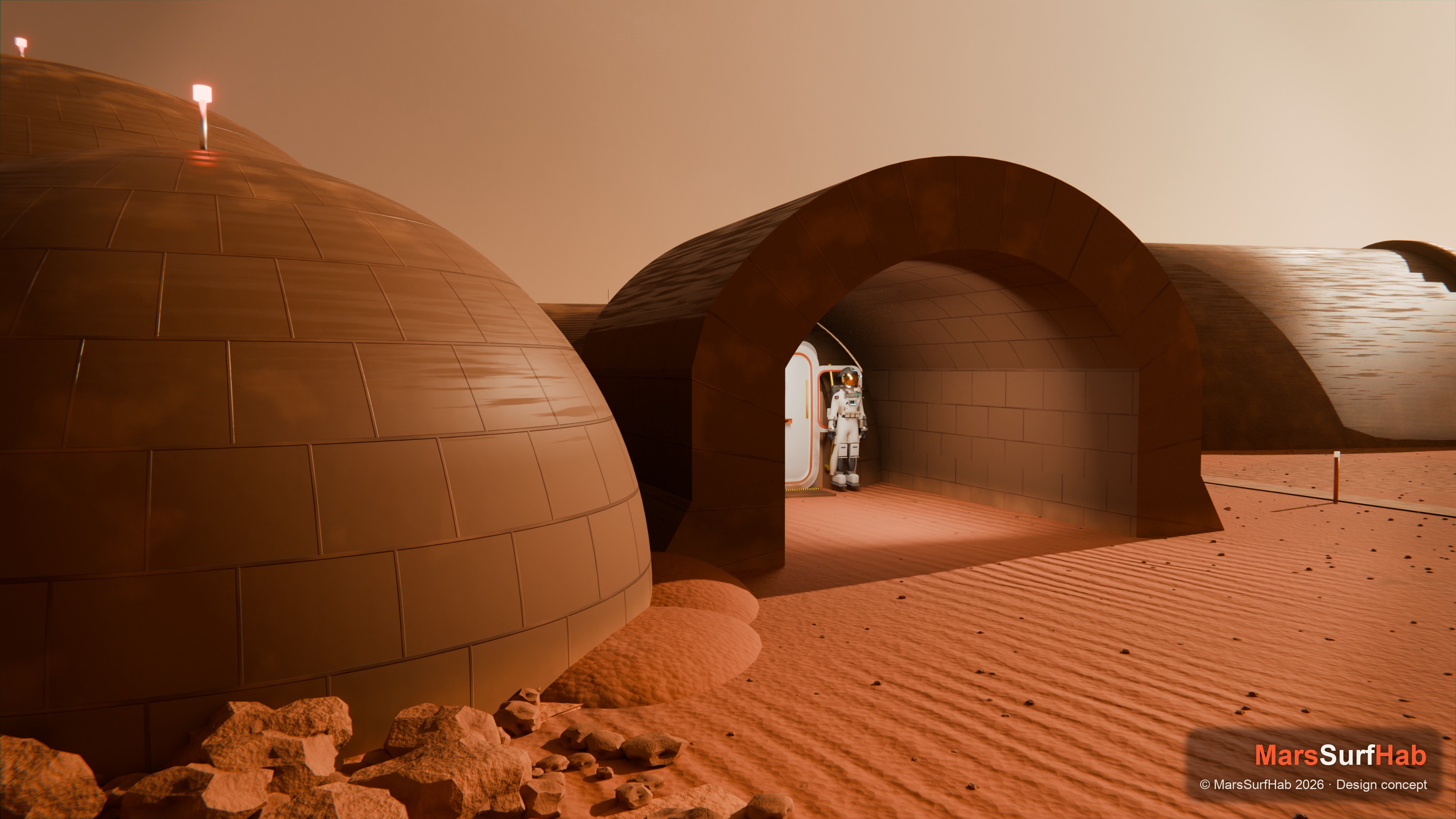
The EVA porch. A catenary barrel vault in pure compression, made of dry-laid kiln-sintered blocks.
10 / BUILD SEQUENCE
Robots build it, the crew moves in
The base is phased across launch windows, following the logic of NASA's Mars design reference architecture25: power, propellant and shelter are proven before anyone is committed to the surface.
Phase 0
Robotic precursor
Lands 26 months before crew
Power units, ISRU plant, excavators, sintering robots
Builds the pad, foundation rings and shells
Cargo pre-deployment, which ESA's 2004 Mars study set as a prerequisite for long stays16
Starts oxygen and propellant production
Phase 1
Pre-crew
Hub and pods inflated inside finished shells
Atmosphere, water and power checked out
Return propellant tanks filling
Crew launch only after go/no-go: shells leak-tested, life support run uncrewed, water walls full, power N+1, propellant verified
Phase 2
Crew of six
Conjunction class: 174 d out, 539 d at Mars, 201 d back25
About 500-sol surface stay
Phase 3
Steady state
Full reactor set and methalox plant
Greenhouse at full output
Pressurised-rover sorties
11 / READINESS
Technology readiness, element by element
On the NASA TRL scale, a system is no more mature than its least mature critical element. Heritage proven in orbit or on Earth is rated lower for the Mars surface until it has been tested in Mars-like conditions. Ratings are our assessment.
Element
Heritage
TRL (LEO / Earth)
TRL (Mars surface)
Key risk
Regolith sandwich shell
ESA / Foster printed lunar shell study
2
2
No test article anywhere; sintering rate and power; cracking
Inflatable hub
BEAM, TransHab, Sierra LIFE
6
4
Deployment in dust; long-term creep; penetrations; flat-cap restraint pattern
Pods
BEAM (Ø 3.2 m class)
9
4
As the hub; water-jacket mass
Airlock / suitports
ISS Quest; Z-1 suitport tests
9 / 4–5
6 / 4
Dust on seals; recovering an injured crew member
Life support
ISS water recovery, OGA, CDRA
9
5–6
Closure, spares, reliability
Oxygen ISRU
MOXIE on Perseverance
7
4–5
About 165× scale-up; stack degradation
Water and methalox ISRU
Honeybee RedWater; ISS Sabatier
5
3–4
Ice access, liquefaction, power
Fission power
KRUSTY (2018)
5
4
Schedule; siting and exclusion zone
Solar and storage
MER, InSight, Perseverance arrays
9
6
Dust; global storms
Sintered landing pad
KSC / Masten LPAD tests (2020, reported 2021)
3
2–3
Erosion; build rate
Greenhouse
EDEN ISS, Veggie
6
4–5
About 50 kW average for about 60 m² (EDEN ISS scaling) est.; crew time
System readiness: TRL 2–3
Set by the regolith shell and the sintered pad. A near-term variant, with bagged regolith instead of sintered skins, an unprepared landing site at a distance and oxygen-only ISRU, would be about TRL 4. The first step we propose is a ground test article of the shell sandwich.
12 / SOURCES
Where the numbers come from
Figures marked est. or sum are MarsSurfHab's own estimates or arithmetic, with the working shown in our design records. Everything else is cited below. CAIRN-7 is a MarsSurfHab design concept; no space agency endorses or funds it.
HiRISE, "Candidate Landing Site for SpaceX Starship in Arcadia Region", ESP_061075_2195, 2019. uahirise.org
G. A. Morgan et al., "Availability of subsurface water-ice resources in the northern mid-latitudes of Mars", Nature Astronomy 5, 2021. usgs.gov
S. J. Hoffman, B. Bussey, "Human Mars Landing Site and Impacts on Mars Surface Operations", IEEE Aerospace 2016. NTRS
NASA OCHMO, "Habitable Atmosphere", Technical Brief OCHMO-TB-003 Rev A, 2023, and the Exploration Atmospheres Working Group report it cites, NASA/TP-2006-213726. nasa.gov
NASA OCHMO, "Carbon Dioxide", Technical Brief OCHMO-TB-004 Rev D. nasa.gov
A. Whitmire et al., "Minimum Acceptable Net Habitable Volume for Long-Duration Exploration Missions", NASA HRP, 2014. NTRS
H. de la Fuente et al., "TransHab: NASA's Large-Scale Inflatable Spacecraft", AIAA-2000-1822, 2000. doi
"Successful failure: Sierra Space's inflatable habitat blows up as planned", TechCrunch, 22 January 2024. techcrunch.com
ESA, "Building a lunar base with 3D printing", 2013. esa.int
J. Zhang, J. Guo et al., "From the Top of Martian Olympus to Deep Craters and Beneath: Mars Radiation Environment Under Different Atmospheric and Regolith Depths", JGR Planets 127, e2021JE007157, 2022. doi
L. Röstel et al., "Subsurface Radiation Environment of Mars and Its Implication for Shielding Protection of Future Habitats", JGR Planets, 2020. geo-leo.de
D. M. Hassler et al., "Mars' Surface Radiation Environment Measured with the Mars Science Laboratory's Curiosity Rover", Science 343, 2014. doi
C. Zeitlin et al., "Measurements of Energetic Particle Radiation in Transit to Mars on the Mars Science Laboratory", Science 340, 2013. doi
NASA OCHMO, "Design for Ionizing Radiation Protection", Technical Brief OCHMO-TB-020 Rev E. nasa.gov
L. Bessone, D. Vennemann (eds.), "Human Missions to Mars: Overall Architecture Assessment", ESA CDF-20(A), ESTEC Concurrent Design Facility, 2004 (no complete public copy online).
M. T. Flynn, M. M. Cohen et al., Water Walls 2018 update report. NTRS
M. K. Ewert, T. T. Chen, C. D. Powell (eds.), "Life Support Baseline Values and Assumptions Document", NASA/TP-2015-218570/REV2, 2022. NTRS
NASA, "NASA Achieves Water Recovery Milestone on International Space Station", 2023. nasa.gov
NASA JPL, "NASA's Oxygen-Generating Experiment MOXIE Completes Mars Mission", 2023. jpl.nasa.gov
J. E. Kleinhenz, A. Paz, "An ISRU Propellant Production System to Fully Fuel a Mars Ascent Vehicle", AIAA 2017-0423. pdf
NASA, "NASA Seeks Industry Feedback on Fission Surface Power", 2025. nasa.gov
M. A. Gibson et al., "The Kilopower Reactor Using Stirling TechnologY (KRUSTY) Nuclear Ground Test Results and Lessons Learned", 2018. NTRS
B. G. Drake (ed.), "Human Exploration of Mars Design Reference Architecture 5.0", NASA-SP-2009-566. nasa.gov
R. M. Boyle et al., "Suitport Feasibility: Development and Test of a Suitport and Space Suit for Human Pressurized Space Suit Donning Tests", ICES 2012. NTRS
M. M. Cohen, "Pressurized Rover Airlocks", SAE 2000-01-2389. sae.org
DLR, "EDEN ISS project presents results of a new greenhouse concept for future space missions", 2019. dlr.de
NASA KSC, "NASA Tests Landing Pad Materials for Future Lunar Missions", 2021 (tests in 2020). nasa.gov
B. Mellerowicz, K. Zacny et al., "RedWater: Water Mining System for Mars", New Space 10(2), 2022. mtu.edu